This story starts on a freezing cold day a few years back, when we were skiing down the face of Mount Snow in Vermont and I got caught on a tricky patch of ice and nearly slid into a tree. As I collected my nerves and tried in vain to search out a less-icy line, I spotted two people calmly and steadily stepping their way uphill towards the summit on skis. They weren’t even wearing coats. As if I was seeing some kind of mirage, I gestured with my pole and shouted to Tim, who was waiting for me at the bottom of the pitch, “What are THEY doing!? I want to be doing THAT!”
A year or two later, we were skiing at Mohawk Mountain in the Northwest corner of Connecticut with some dear friends from Darien – Emma’s bestie since 1st grade and her two sisters, one of whom happens to be one of the best science students I’ve ever had. As we all froze on the lift, their dad was practically lapping us down below on his ultra-lightweight skimo racing skis. I’m pretty sure Jeff didn’t even have a lift ticket – he’d put his girls on the lift and then meet them at the top of the run. We were in the presence of some serious stoke.
Later the following summer, Jeff introduced us to Julie at Pacific Cycling and Triathlon in Stamford, CT, and she set us up with Hagan Ultra 65 skis mounted with Hagan Ultra World Cup bindings, along with the most incredibly light and comfortable yet stiff and responsive boots we’ve ever worn, the Hagan Core Pro Carbon boots. And of course, the requisite “skins” that adhere to the bottom of the skis, allowing traction for climbing uphill.
This was, unbeknownst to us, the smartest and best purchase we would make in 2019, because when the Covid-19 pandemic hit the U.S. at the end of the following ski season and resorts shut down, we kept on skiing wherever we could find snow. Also, touring or skimo setups (“skimo,” short for ski mountaineering, is also known as AT, for alpine touring, uphilling, skinning, etc) became harder to obtain during the pandemic, perhaps both because people suddenly had time to invest in fitness and outdoor gear and were looking for safe, sanity-saving outdoor pursuits, and also because of the real fear skiers had that ski resorts, and thus lifts, wouldn’t operate as usual the following season. In the winter of 2020, we were able to ski outside resorts whenever we wanted to – one memorable trip was to New Hampshire where we spent President’s Day weekend in the Presidential range. We stayed at the historic Joe Dodge Lodge at the base of the Tuckerman Ravine Trail, which we skied up and then came back down the Sherburne ski trail (now affectionately called by the kids the “Sherbie,” or the “Sherb”). The Sherburne has slope angles ranging from 19-25 degrees; it’s hard to equate backcountry pitches to resort runs given that conditions vary so widely and are a major determinant of difficulty, but most sources say the Sherbie is like an intermediate/blue run at a resort. It’s wildly fun and has a rustic, adventurous feel, thanks to brilliant trail-cutting by the CCC — the Sherb is something every New England skier should experience!



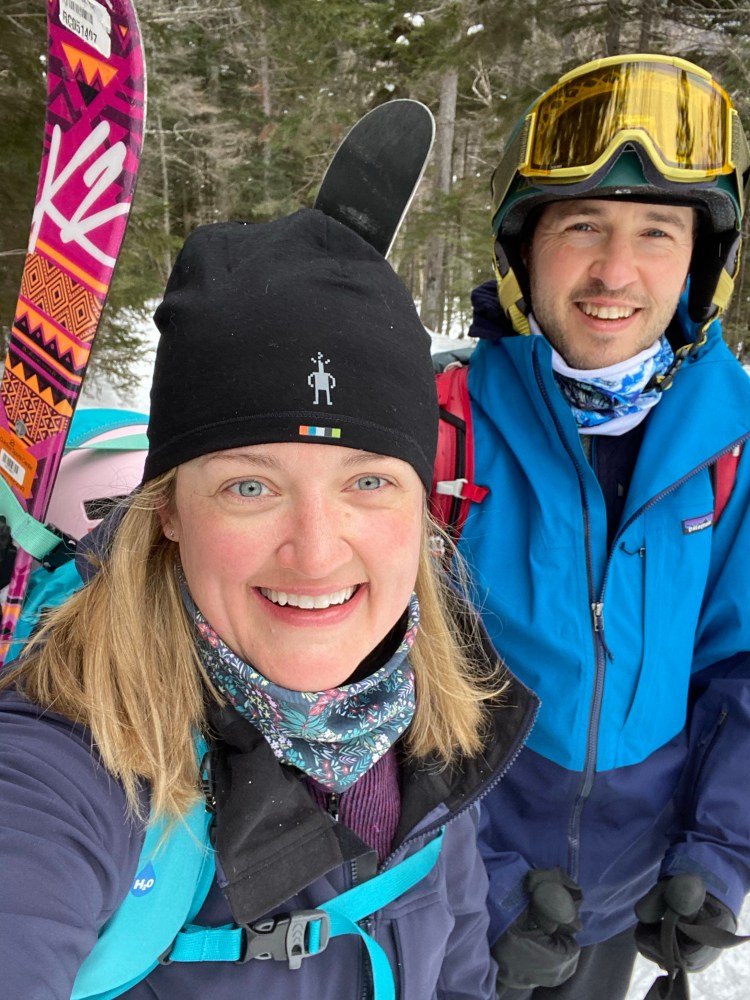


Now, the kids did not yet have touring setups — the way we handled this was to pack their ski boots into giant backpacks with their skis buckled onto the sides. Tim and I wore Emma’s gear, but Graham insisted on carrying his own pack with boots and skis. They hiked up the TRT in snowboots while we skied alongside them, and they changed into their skis and boots at the transition point before skiing back down the Sherb (which was freezing cold — we had to do this as fast as possible to keep their feet warm).
That weekend in NH, we also explored some of the gladed terrain maintained by the Granite Backcountry Alliance (the kids’ favorite was oddly located behind a hypnosis center. With ski touring setups – or at least the willingness to bootpack up carrying your skis – you can find good skiing almost anywhere).


I’m not exaggerating when I say these skimo racing skis changed my winter life. First of all, they’re so light and maneuverable that I’ll confidently drop into runs I wouldn’t have attempted in the heavy, clunky seasonal ski rentals I was accustomed to. They maintain a great edge in powder, ice, crud, or corduroy. I’m not a super aggressive skier, but I’m confident in saying that despite the light weight of these skis and boots, the setup is highly responsive, control is excellent, and I’ve never experienced the “chattering” people complain about with lighter skis on fast descents – though I keep my maximum downhill speed at about 20-25 mph. The way they slip nimbly over and around moguls is a revelation. At the end of a day of resort skiing on heavy rental skis, my knees used to get sore and tired from the weight of my skis and boots dangling off the lift, but this gear is just a joy to feel on, whether I’m climbing, riding lifts, carrying gear back to the car, or skate-skiing across flats. And that’s just comparing these skis to regular downhill skis. The real secret sauce is the way mountains open up to you when you can not only descend but also ascend them on skis. For us, skiing is no longer solely about the downhill.
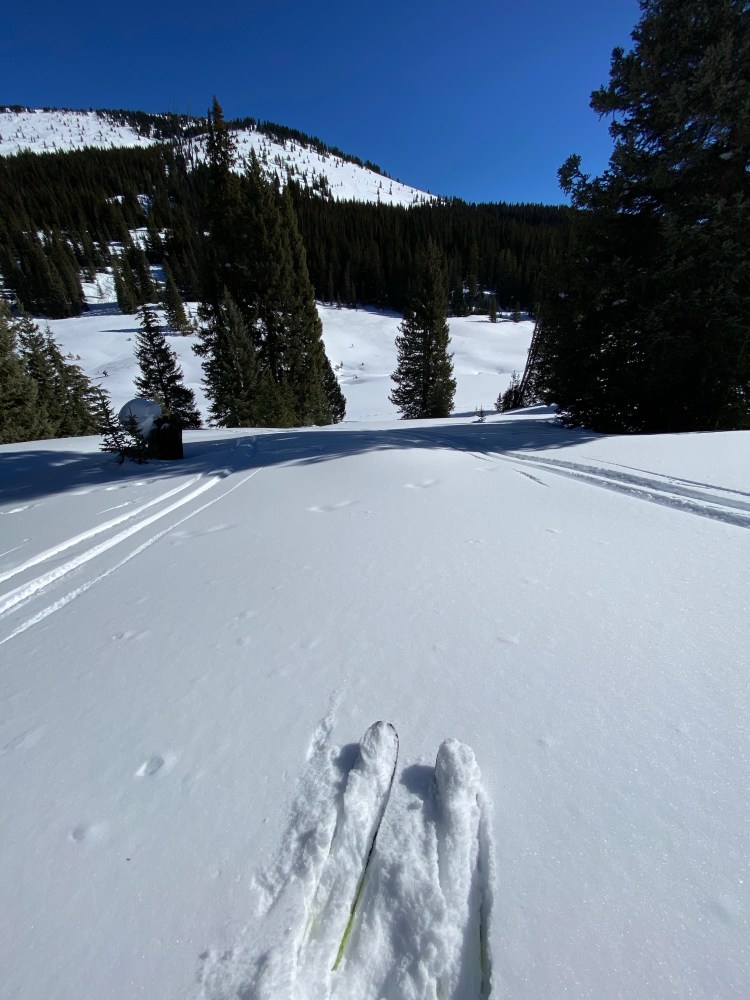
The following year, in the spring of 2021, when we had decided to take a family travel year, we went back to see Julie at Pacific and purchased ski touring setups for the kids. This was perhaps the most extravagant “gearing up” we did for the trip, and had we been local, we might have tried to rent touring skis, but we needed them all over the country for a long season of chasing snow. And our kids are 9 and 12 – while our older son will likely outgrow his after 1-2 seasons, his little sister will be able to wear his forever when she outgrows hers (his skis are longer than mine at 158cm, and his boots are size 25.5, equivalent to about a women’s size 7.5). Julie is the most understated but spot-on ski and boot fitter – she nailed our kids’ sizes, even in her estimations of growth given that we ordered them almost a YEAR in advance, and we couldn’t be happier with their fit and performance. In terms of performance, I will say their Dynafit Seven Summits setups are heavier and wider than our Hagans, plus their wide skins are as sticky as glue traps, requiring some muscle to pull apart and some coordination to align on the ski. The kids needed some help with transitions initially (After our AIARE 1 weekend, Graham is fully practiced and ready with his, though Emma still needs help, especially when she’s tired after a long ascent). However, their skis probably also perform a little better descending in the backcountry where there is often deep tracked powder or variable conditions that can be more challenging in our light and skinny Hagan skis.
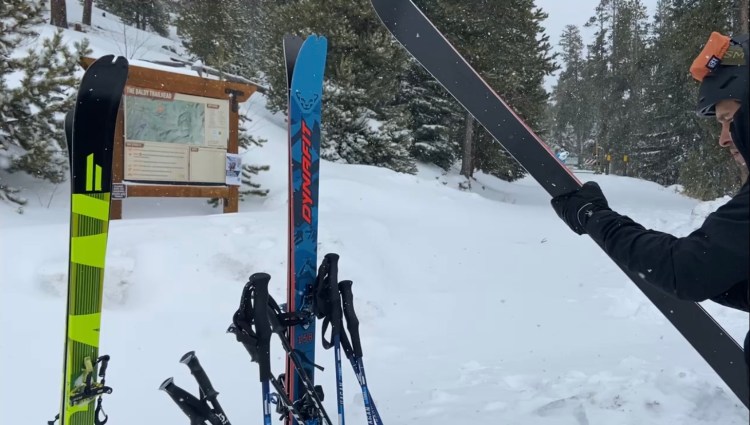
When it comes to equipment and techniques, we are far from purists – as a result of our minimalist-leaning efforts to keep our footprint small (and our budget reasonable) we try to creatively maximize the use we get from a minimal amount of gear. I won’t claim our philosophy of gear flexibility is always optimal for conditions. For example, these days we do all our ambulating in trail running shoes – this means whether we’re road running, going on a 10 mile hike with 3,000’ elevation gain, or working out in the gym, we are generally wearing trail runners. Tim and I only have hybrid bikes with skinny tires and no shocks, yet we’ll accompany the kids on craggy MTB trails. And we didn’t want to find space for 8 bulky helmets in our rig, so we only brought ski helmets – which got a little sweaty when we wore them biking in Utah in the fall. Our minimalist approach to gear also means the family ski quiver contains only one pair of skis for each person. But our touring skis, in our opinion, do it all.
Here’s Emma’s description of our Baldy ascent in Breck:
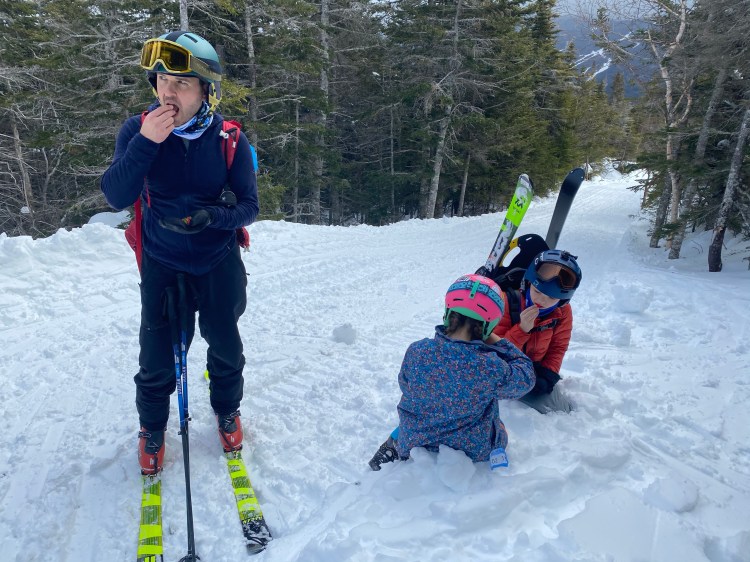
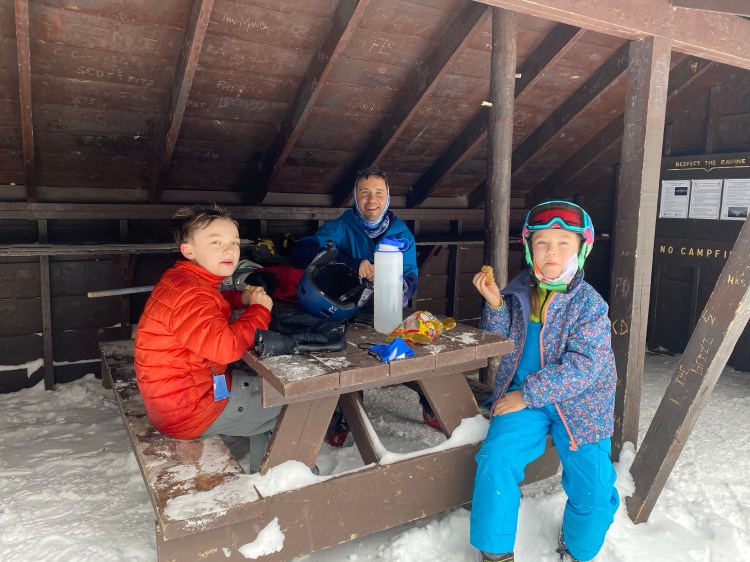
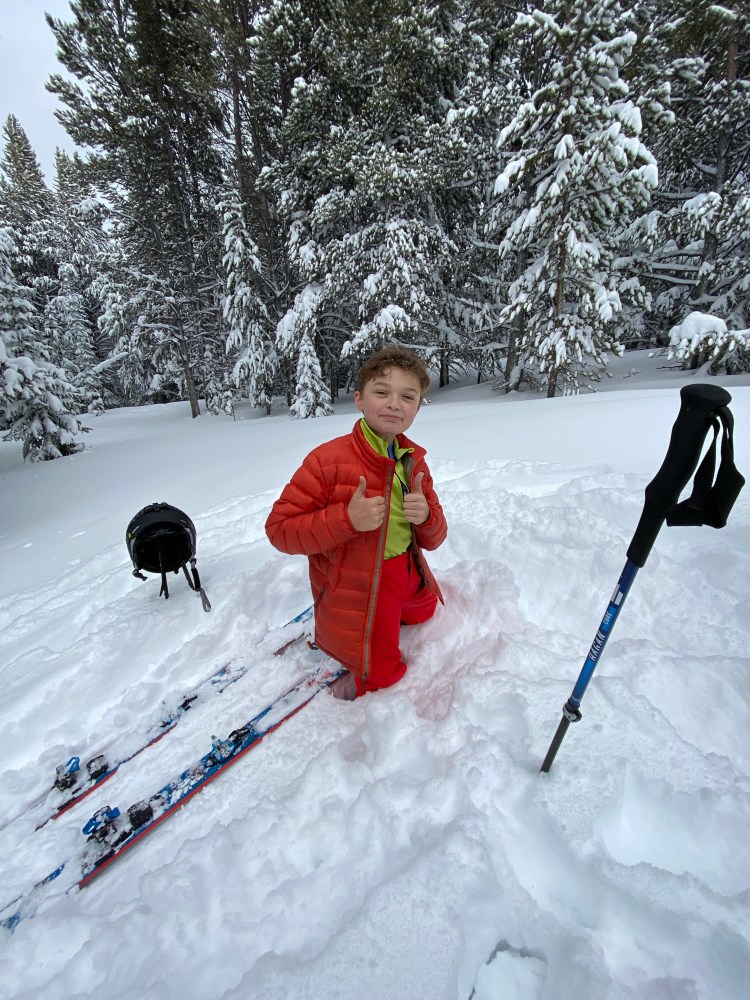
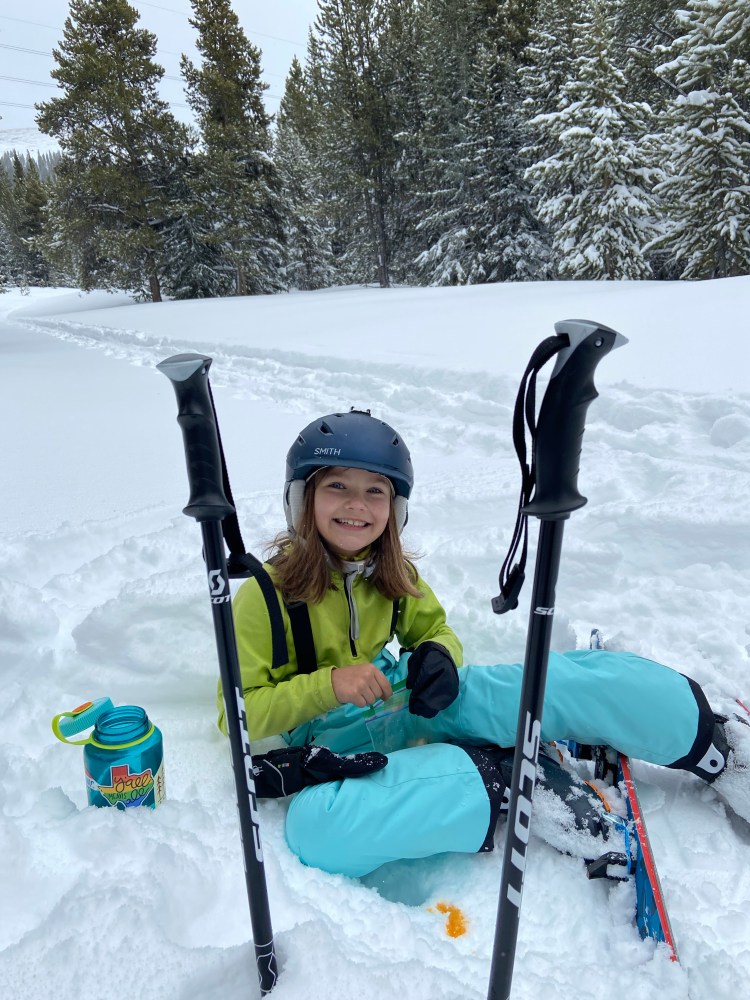
I leaped up the mountain, occasionally looking back to see my family, right behind me. Today it was actively snowing, and we were making use of our new uphill skis. I looked down at my boots, covered in flakes of cold powder. Then my eyes flitted to the snow, and I stared up at the tree tops, dusted in snow. Every once in a while a squirrel or small bird would walk along the branch, knocking snow off as they went. When this happened, I would duck my head, and glide forward with as much force as I could muster. When you uphill you get very hot, so we also stopped frequently to take off some layers. Uphilling is like skating up the mountain. Your right foot glides, then your left follows, and suddenly you don’t even know you’re doing it. We made a quick lunch stop about half way up, and either stood, or sat, depending on how brave we were feeling that day. Me and Graham cautiously took off our skis to sit in the deep powder, while our parents stood on their skis. We ate clementine segments and little slices of grilled chicken, and soon we were all satisfied. Probably about ten minutes later, we hauled ourselves up and trudged onward. The higher we went, the harder it became. On the way up, I sidestepped up a hill on the side, and soon my brother was in my tracks. Without transitioning, I sailed down the short incline, and fell in the soft powder at the bottom. The rest of the way down was fun but quick. There were posed pictures, capturing memories, and shrieks of WOOHOO! I quickly passed my brother, leaving him dumbfounded, and we raced, and sang out MUSCLES OVER MOTORS!!!

 The Peace of Wild Things